SEBI Registered RA (INH000003507)
BSE Enlistment No:5203


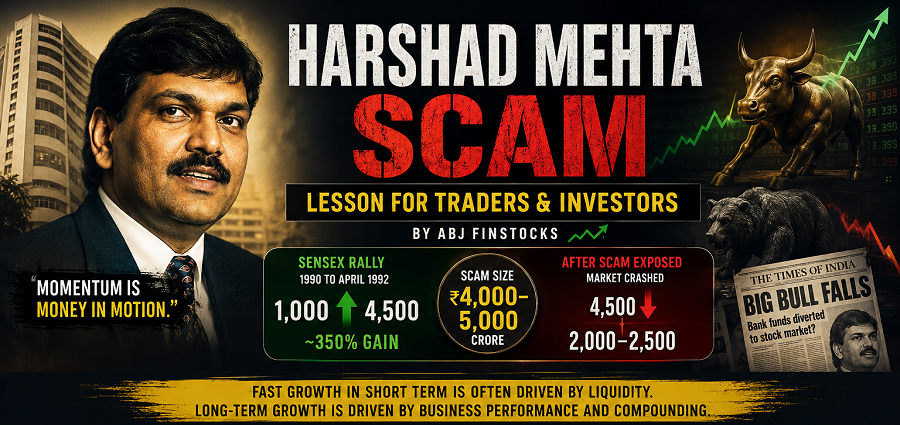
Harshad Mehta Scam
Harshad Mehta Scam the BSE Sensex was around 1,000 points in 1990 and surged to nearly 4,500 points by April 1992, delivering a gain of approximately 350% in just two years. The estimated scam size was around ₹4,000–5,000 crore, involving diversion of banking funds into the stock market through loopholes in the financial system. After the scam was exposed, the Sensex corrected sharply to around 2,000–2,500 levels.
Lets Decode Harshad Mehta Here…
Massive Success
He rose from being a relatively small broker in the 1980s to becoming one of the most influential market operators in India by 1991–92.
He owned luxury assets that were extraordinary for that era, including a large sea-facing residence and high-end cars.
He controlled or influenced positions worth hundreds and, at times, thousands of crores through market operations and financing arrangements.
The estimated scam exposure was around ₹4,000–5,000 crore, which gives an idea of the scale at which he was operating.
Reason Of Success
In the late 1980s and early 1990s, Harshad Mehta understood something many market participants overlooked: liquidity can move prices faster than fundamentals.
When money enters the market aggressively, prices can rise much faster than earnings. He recognized how banking liquidity, particularly through the Ready Forward (RF) mechanism, could create powerful momentum in select stocks. The Harshad Mehta episode highlights one of the most powerful forces in the stock market—liquidity.
This remains a timeless market truth:
Momentum is not magic. It is money in motion.
How things moved?
Harshad Mehta’s success was built on his understanding of liquidity and the banking system. During the early 1990s, banks frequently entered into Ready Forward (RF) deals, which were short-term transactions backed by government securities. As a broker, Harshad Mehta acted as an intermediary between banks. Through irregular use of Bank Receipts (BRs) and weaknesses in the settlement system, large sums of money that were intended for government securities transactions became available for stock market purchases.
These funds were then used to buy shares aggressively, creating strong demand and pushing stock prices sharply higher. As prices rose, more investors entered the market, further increasing momentum. The rising stock prices created an impression of exceptional opportunities, attracting additional participation and liquidity. This cycle continued as long as fresh money kept entering the market.
However, the structure depended heavily on continuous liquidity and confidence. Once irregularities in the transactions were discovered, banks and regulators tightened controls and demanded settlement of funds. The flow of money stopped, liquidity dried up, and stock prices began to fall. What had fueled one of the biggest bull runs in Indian market history quickly turned into a sharp market correction. The episode remains one of the most powerful examples of how liquidity can drive markets far beyond fundamentals, but also how quickly momentum can reverse when that liquidity disappears.
What Went Wrong?
Harshad Mehta was intelligent, influential, and deeply aware of how markets functioned but in short term but what was needed to create a long-term story he was not having idea.
Once liquidity was tightened, the rally could no longer sustain itself.
Markets delivered one of their oldest lessons:
Liquidity can create momentum, but it cannot permanently replace fundamentals.
Fast growth in the short term is often driven by liquidity. Long term Growth, however, is driven by business performance and compounding.
The Harshad Mehta episode therefore gives investors an important distinction between a stock that is rising because money is chasing it and a business that has the ability to create value over many years. When looking for multibagger stocks for next 5 years, the focus should not remain only on momentum or a sharp rise in share price. Business growth, financial strength and the ability to sustain performance after market liquidity normalises are equally important. The same lesson applies while identifying best undervalued stocks to buy now: temporary market pessimism or optimism should be separated from the actual value and prospects of the underlying company.
This becomes even more relevant in segments where liquidity can cause particularly sharp movements. Investors researching fundamentally strong penny stocks should distinguish between rallies created primarily by market participation and companies where improving business performance can support long-term growth. Likewise, while evaluating best shares to buy for long term, the lesson from 1992 remains useful—liquidity and momentum can influence what happens to a stock today, but the strength of the underlying business plays a much larger role in determining what an investment can become over the years.
From this rise and downfall
Lesson for Traders & Investors