SEBI Registered RA (INH000003507)
BSE Enlistment No:5203


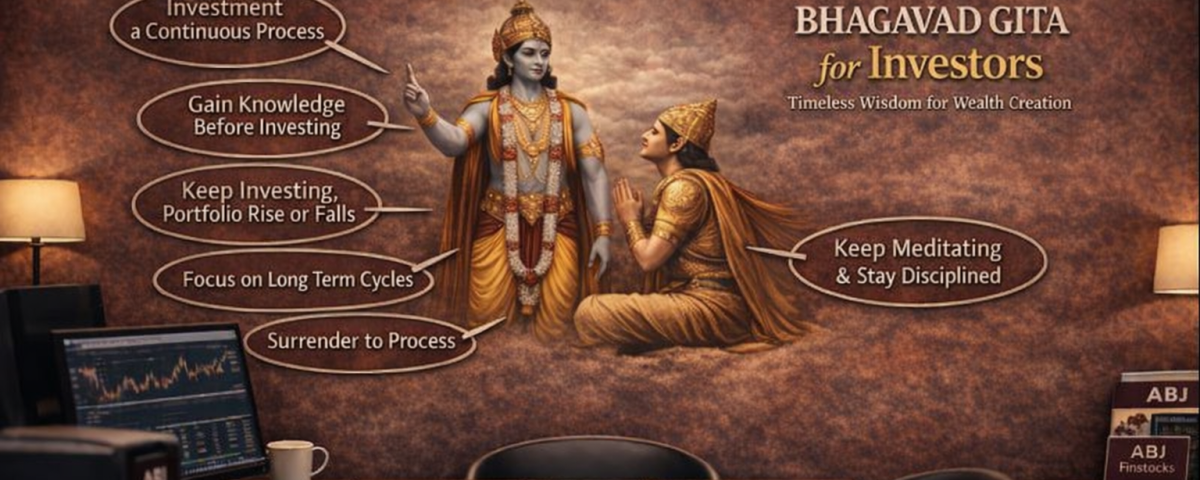
Learn stock market, share market, share bazar by relating Bhagwad Gita Teachings
Stock market learnings,The Bhagavad Gita is not just a spiritual scripture. It is a masterclass in decision-making, discipline, emotional control, and long-term thinking — everything a serious investor needs.
Below is a chapter-wise interpretation:
Let’s decode investing through the Gita.
Chapter 1: Arjuna Vishada Yoga
(The Yoga of Arjuna’s Dilemma)
What It Says to Arjuna:
Arjuna stands on the battlefield, overwhelmed.
He sees consequences, risks, relationships, and possible losses.
His emotions overpower his strategy. Fear replaces clarity.
What It Says to Investors:
When the Market Is at the Bottom/Top
Fear of more fall in falling market.
Fear of top out /correction when market is on high
Lesson: Confusion is natural. Acting emotionally is optional.
Core Insight:
Arjuna’s dilemma is not about war.
It is about emotional paralysis before major decisions.
In markets, both panic and greed distort judgment.
The wise investor recognizes emotion — but does not surrender to it.
Chapter 2: Sankhya Yoga (The Yoga of Knowledge)
What It Says to Arjuna:
Krishna introduces clarity. He explains the difference between temporary and eternal. He teaches detachment from outcomes.
What It Says to Investors:
Markets fluctuate. Businesses evolve. Prices move daily.
But:
Key Investment Lesson:
Focus on process, not daily P&L.
“Do your duty, do not attach to results” =
Invest based on research, not market noise.
Chapter 3: Karma Yoga (The Yoga of Action)
What It Says to Arjuna:
Act. Do your duty. Avoid inaction. Right action is superior to paralysis.
What It Says to Investors:
Waiting endlessly for the “perfect price” is also a mistake.
In investing:
Inaction due to fear destroys more wealth than mistakes.
Chapter 4: Jnana Karma Sanyasa Yoga
Before Action (Preparation Stage)
What It Says to Arjuna:
Krishna says:
What It Says to Investors:
💡 Investor takeaway:
Chapter 5: Karma Sanyasa Yoga
Action Phase (Doing the Work)
What It Says to Arjuna:
Detach from ego and selfish desires.
What It Says to Investors:
Ego investing destroys portfolios.
Detachment means:
Invest equally in all Stocks
Don’t invest all money together.
Chapter 6: Dhyana Yoga (The Yoga of Meditation)
Dhyāna = systematic mental training for inner stability
It is the disciplined practice of making the mind steady, focused, and undisturbed by external fluctuations.
What It Says to Arjuna:
Meditation/Dhyana means Training the mind to remain stable and undisturbed on Krishna.
What It Says to Investors:
Meditation/Dhyana in investment means Training the mind to remain stable in the investment process
Chapter 7: Jñāna–Vijñāna Yoga (The Yoga of Knowledge and Realization)
What It Says to Arjuna:
Krishna explains His true nature — both material and spiritual.
He teaches not just theoretical knowledge (Jñāna), but realized understanding (Vijñāna).
It is about knowing reality deeply, not superficially.
What It Says to Investors:
In markets too, there are two layers:
1️⃣ Material layer — numbers, price, balance sheet, ratios, news flow
2️⃣ Higher layer — management intent, capital allocation mindset, business quality, behavioral cycles
Most investors stop at the material layer (data).
Few understand the higher layer (quality + behavior + structure).
And again:
Investment Insight:
Successful investing requires understanding both the visible numbers and the invisible drivers behind them.
Chapter 8: Akṣara Brahma Yoga (The Yoga of the Imperishable Absolute)
What It Says to Arjuna:
Krishna explains the eternal (Akṣara) versus the temporary world.
He emphasizes remembering the Supreme even at the time of death — meaning, staying aligned with the eternal truth at critical moments.
What It Says to Investors:
Markets are temporary.
Cycles are temporary.
Capital preservation and long-term discipline are enduring principles.
This chapter teaches:
Investment Insight:
What survives cycles matters more than what shines temporarily.
Chapter 9: Rāja Vidyā Rāja Guhya Yoga (The Yoga of the Most Confidential Knowledge)
What It Says to Arjuna:
Krishna reveals the most confidential truth — that devotion and surrender with faith lead to the highest realization.
He explains that divine reality sustains everything, even if unseen.
What It Says to Investors:
There are deeper principles in markets beyond visible price movement.
This chapter teaches:
Investment Insight:
The most powerful force in markets is often unseen — compounding over time.
Chapter 10: Vibhuti Yoga (The Yoga of Divine Manifestations)
What It Says to Arjuna:
Recognize greatness where it exists.
He says, in essence:
What It Says to Investors:
Identify great businesses early.
Traits of great companies:
Greatness compounds.
Wherever you see excellence, power, brilliance, or greatness — that is a manifestation of the Divine. Vibhuti Yoga is about recognizing the highest excellence as an expression of the Supreme.
Chapter 11: Vishwaroopa Darshana Yoga (The Universal Form)
What It Says to Arjuna:
Krishna reveals the vast, unstoppable nature of time.
What It Says to Investors:
This chapter teaches investors: Markets are bigger than you.
Chapter 12: Bhakti Yoga (The Yoga of Devotion)
What It Says to Arjuna:
Stay devoted, steady, and balanced.
What It Says to Investors:
Long-term wealth requires patience.
Multi-baggers are not created in months.
They require years of conviction.
Chapter 13 – Kṣetra-Kṣetrajña-Vibhāga-Yoga
Meaning: Yoga of the distinction between the Field (Body/Material) and the Knower of the Field (Soul)
What It Says to Arjuna: Distinguish between the perishable body (Kṣetra) and the eternal soul (Kṣetrajña). Knowledge of self leads to liberation.
What It Says to Investor: Understand the difference between material assets (stocks, money) and your own skills, strategy, and discipline. Don’t let market fluctuations control you; focus on your long-term financial wisdom.
Chapter 14 – Guṇatraya-Vibhāga Yoga (How your mind thinks)
Meaning: Understanding the Three Modes that shape human intelligence (Sattva, Rajas, Tamas)
What It Says to Arjuna: Your thinking and actions are influenced by three mental forces:
Sattva: clarity, balance, higher understanding
Rajas: ambition, attachment, restless desire
Tamas: ignorance, confusion, negligence
What It Says to Investor: Recognize your intelligence pattern before acting:
Develop clear, data-driven, rational decisions (Sattva)
Control over-ambition and emotional reactions (Rajas)
Avoid careless analysis or blind holding (Tamas)
Chapter 15 – Puruṣottama Yoga
Meaning: Yoga of the Supreme Person
What It Says to Arjuna: The eternal soul is distinct from the temporary body; ultimate reality is the Supreme Person (Krishna). Devotion and understanding lead to liberation.
What It Says to Investor: Understand long-term vision: material gains are temporary, principles and strategy are eternal. Align your investments with long-term goals rather than chasing short-term gains.
Chapter 16 – Daivāsura-Sampad-Vibhāga Yoga (What your values choose.)
Meaning: Understanding the Division between Divine and Demoniac Qualities (Moral Character)
What It Says to Arjuna: Beyond intelligence, your destiny depends on your moral nature:
Daiva: integrity, discipline, humility, responsibility
Asura: greed, ego, arrogance, manipulation
What It Says to Investor: Character determines long-term sustainability:
Practice ethical investing, patience, and self-control (Daiva)
Avoid shortcuts, market manipulation, and ego-driven decisions (Asura)
Chapter 17 – Śraddhā-Traya-Vibhāga Yoga (As your faith, so your result)
Meaning: The Yoga of the Threefold Division of Faith (Conviction determines direction)
What It Says to Arjuna: A person becomes what their faith is. Faith arises from one’s nature and is of three kinds:
• Sattvic: pure, balanced, truth-aligned
• Rajasic: desire-driven, result-focused
• Tamasic: blind, confused, irrational
Krishna teaches that your inner belief system shapes your actions and therefore your destiny — “Jaisi śraddhā, waisa phal.”
What It Says to Investor: Your financial results reflect your conviction pattern:
• If you believe in discipline, research, and long-term compounding (Sattvic), wealth grows steadily
• If you believe in fast profits and constant comparison (Rajasic), outcomes become volatile
• If you believe in tips, luck, and blind following (Tamasic), confusion and losses follow
Chapter 18 – Mokṣa-Sannyāsa-Yoga
Meaning: The Yoga of Liberation through Renunciation (Freedom by letting go of attachment)
What It Says to Arjuna: Perform your duty with full commitment, but renounce attachment to the fruits of action. Liberation (Moksha) comes when the mind is free from anxiety, ego, and result-dependence — not when action is abandoned.
What It Says to Investor: True financial maturity comes when you stop obsessing over portfolio value and focus on disciplined execution:
Follow your strategy consistently
Do research and manage risk properly
Act without emotional attachment to daily gains or losses
Core Insight:
When you drop psychological attachment to portfolio value,
clarity improves, emotional mistakes reduce, and disciplined action strengthens.
Final Message for Investors
The Bhagavad Gita is not about war. It is about decision-making under uncertainty.
Markets are modern Kurukshetra.
Fear, greed, ego, impatience — these are investors enemies.
Krishna’s core message to Arjuna was:
Act with knowledge.
Stay disciplined.
Detach from short-term outcomes.
Focus on duty.
For investors, that translates to:
You don’t just invest better —
You think better.
Note:
In the Bhagavad Gita, the word “Yoga” does not mean physical exercise.
Yoga means a disciplined path or method of inner alignment that leads to higher understanding or liberation.
Whether your objective is finding multibagger stocks for next 5 years, identifying best value stocks to buy now, or exploring best penny stocks to buy now, successful investing begins with disciplined research rather than speculation. At ABJ Finstocks, our SEBI-registered research team offers dedicated investment services for long-term wealth creation through carefully researched Multibagger Stocks, Value Stocks, and Penny Stocks, helping investors make informed decisions based on analysis instead of market noise.