SEBI Registered RA (INH000003507)
BSE Enlistment No:5203


algo trading
Algos in Trading: A Reality Check
We are writing this blog to give you a clear picture of what algos really mean in the trading world.
But unfortunately, the biggest roadblock is lack of good coders. This is why large players like FIIs (Foreign Institutional Investors) dominate in using them.
Even if one finds skilled coders, we must remember a simple truth:
Algo = Automation. Nothing more.
It does not mean a guaranteed money printer.
The algo (robot) can only execute what you feed into it. That means you still need a strong strategy, planning, and tricks of the trade. Without that, it’s just a tool following empty instructions.
A robot is useful only up to the limit of the brain of its maker — never more. Think of it as just a physical body carrying out orders, not an independent money-making mind.
For them, algos aren’t just about saving time — they’re about protecting capital, lowering execution cost, and scaling strategies globally.
Case 1 – FII Arbitrage Algo
Large FIIs run algos that exploit price differences between Nifty futures in Singapore and India. If the gap appears even for a fraction of a second, their algo buys in one market and sells in the other. The profit per trade is tiny (maybe just a few paise), but repeated thousands of times a day with huge volumes, it becomes meaningful.
Case 2 – Retail Trader with Stop-Loss Algo
A retail trader can use a simple algo that automatically places a stop-loss as soon as a position is taken. This way, even if emotions kick in or the trader steps away from the screen, the system protects the capital. It doesn’t make the strategy profitable by itself, but it removes the emotional weakness of “not booking a loss in time.”
👉 Bottom line: Algos are powerful tools, but they don’t replace human skill, strategy, and discipline. They only execute what’s inside your head — faster and without emotions.
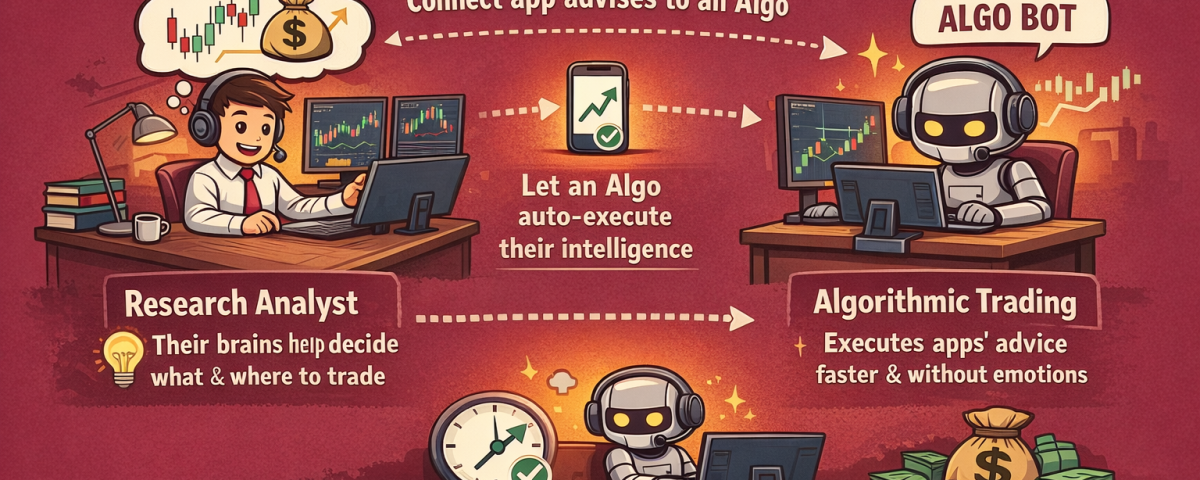
So if you are having confusion Trade as Algo says or Trade as stock advisor says then it’s a wrong thinking process they both are not substitutes. Algo is substitute of manual trade or automated trade. Which direction to trade is given either by your strategy or your stock advisor.
You can do other way select your Research Analyst connect their apps advise to your algo. Reason being is, suppose you know my analyst is giving positive returns from so much time still I am not able to make money from it. Maybe because few days bad and then I am not able to trade on their calls and then series of profits start so better connect your algo with the app your adviser publishes calls and get benefited. Because algo don’t have their own brains that you have to give it.