Personal Finance
Personal finance is not about sacrificing your desires, restricting your lifestyle or compromising on the things you love. It is about enjoying life with financial responsibility. The objective of managing money should not be merely accumulating savings but creating the financial capacity to live the life you desire without compromising your future financial security.
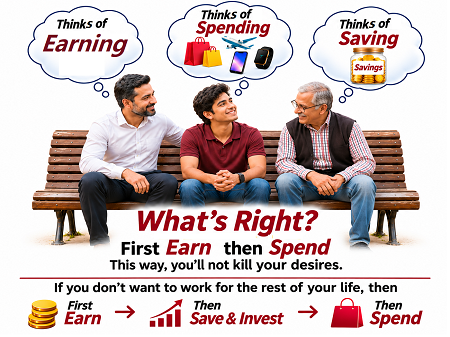
Different generations generally have different priorities when it comes to money. Older generations tend to focus on saving, middle-aged individuals concentrate on earning, while younger generations are often more inclined towards spending. Instead of choosing one approach over another, the right balance lies in combining all three and understanding the correct sequence of earning, saving, investing and spending.
First Earn, Then Spend
For youngsters, one of the most important financial lessons is to understand the relationship between earning and spending. Travelling, buying expensive gadgets, wearing branded clothes and enjoying a luxurious lifestyle are not wrong. However, developing the ability to independently afford these desires is equally important.
If you are not earning, allow your parents to decide how much they can comfortably spend on you. If you want to spend beyond that, focus on earning first rather than increasing the financial burden on your parents.
Instead of constantly being told to control your desires, change the direction of your thinking. If you want to spend more, work towards earning more. This mindset encourages you to develop new skills, explore career opportunities, improve productivity and increase your earning potential.
When your desired lifestyle becomes a motivation to earn more, your aspirations can become a driving force for personal and professional growth. You do not necessarily have to kill your desires; you need to develop the financial capacity to fulfil them responsibly.
Change the priorities of your thinking, planning and execution. Rather than planning your spending first and arranging money later, plan your earnings first and spend accordingly.
For Financial Freedom: First Earn, Then Save and Invest, Then Spend
Earning before spending is a good financial habit, but earning and spending alone may not lead to financial freedom. If you spend everything you earn, you may remain dependent on your active income for the rest of your life, irrespective of how much you earn.
If you do not want to work for the rest of your life, introduce saving and investing between earning and spending. Allocate a portion of your income towards building financial security and creating assets that have the potential to generate future income.
Saving helps you prepare for emergencies and unexpected financial requirements, while investing provides an opportunity to grow your wealth over time. Together, they can help you gradually reduce your dependence on active income.
The purpose of investing should not be limited to accumulating wealth. It should also be about creating potential sources of passive income that can support your lifestyle in the future. Interest, dividends and rental income are some examples, although their sustainability and returns depend on the underlying assets and associated risks.
As your income increases, aim to increase your savings and investments alongside your spending. This allows you to enjoy an improving lifestyle while simultaneously working towards financial independence.
Financial freedom is not about having unlimited money. It is about having sufficient financial resources to make working a choice rather than a necessity.
Earn to fulfil your desires today. Save and invest to enjoy your freedom tomorrow.