SEBI Registered RA (INH000003507)
BSE Enlistment No:5203


Stock Market Price Action.
Stock Market Price Action , Most people think stock prices rise because buyers outnumber sellers. That explanation sounds correct—until you realize every trade in the market already has one buyer and one seller. So if buyers and sellers are always equal, what is really pushing prices up and down? Understanding this can completely change the way you look at the stock market.
1. Stock Market Participants
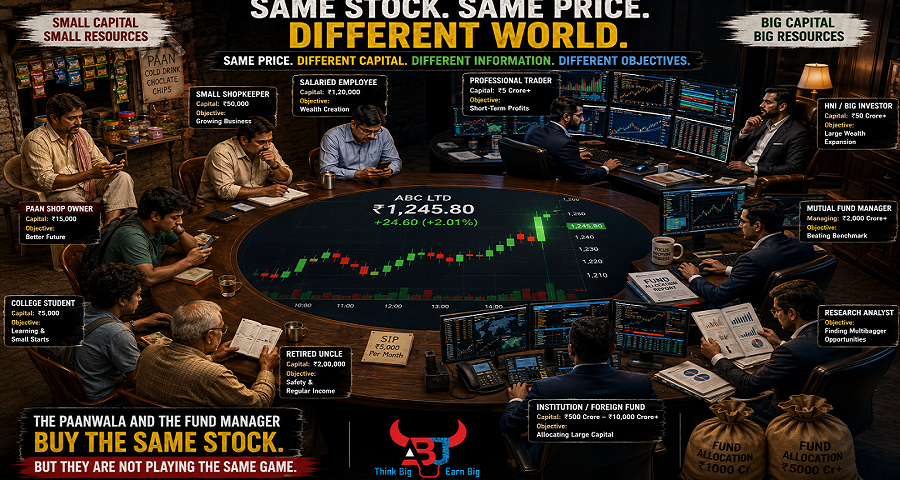
The stock market is a common table where everyone sits together. The market does not care about profession, status, or education. Everyone participates in the same auction.
A paan shop owner, a doctor, a CEO, a politician, a trader, a mutual fund manager, and a foreign institution can all buy the same stock at the same time.
But they are not playing the same game.
One wants profits by tomorrow.
One wants returns over 10 years.
One is deploying ₹10,000.
Another is deploying ₹1,000 crore.
2. What Moves Prices?
Prices move because of demand and supply. This is what most people are taught.
3. But There Is a Contradiction
Buyers and Sellers Are Always Equal. Then Why Does Price Rise?
This is where many investors get confused.
Every executed trade in the stock market always has one buyer and one seller. Otherwise, the trade cannot happen. So technically, buyers and sellers are always equal.
Then why do prices rise?
The answer is that prices do not move because buyers are numerically greater than sellers. Prices move because of aggressiveness and available liquidity at a particular price level.
For example, suppose only 100 shares are available for sale at ₹100, but many buyers want to purchase immediately. Those 100 shares get consumed quickly. The remaining buyers must now purchase from sellers offering shares at ₹101, then ₹102, and so on. As buyers keep accepting higher prices, the stock price rises.
Similarly, during panic selling, buyers still exist in every trade. However, sellers become more aggressive and are willing to accept lower and lower prices to exit quickly. As they hit lower bids, prices fall.
Think of the market as an auction. Trades always happen on a one-to-one basis, but prices change depending on which side is more desperate and which side is forced to compromise on price.
4. Aggression Matters More Than Numbers
Price movement is not determined by how many buyers or sellers exist. It is determined by who is more aggressive. Buyers who are willing to pay higher prices move markets upward. Sellers who are willing to accept lower prices move markets downward. The market rewards urgency, not headcount.
5. Liquidity in the Stock Market
For prices to move significantly, liquidity is required. Liquidity can come from institutions, funds, retail participation, corporate developments, earnings growth, economic events, positive news flow, media coverage, analyst opinions, and market narratives. The more participants willing to act in the same direction, the greater the impact on price.
6. The Reality Retail Investors Face
The market is not fully transparent. You do not know who is on the other side of your trade. It may be an institution, a professional trader, a fund manager, a large operator, or someone with better information, deeper research, stronger conviction, or greater liquidity. This is not necessarily cheating—it is simply the reality that different participants possess different levels of power and influence.
7. Final Message
The market is ultimately a battle for price. Different participants try to influence price through capital, conviction, research, information, and liquidity. Some can influence price more than others, but no one controls it forever.
As a retail investor, your edge is not power. Your edge is knowledge, discipline, patience, risk management, and understanding how the game is actually played.
Let others show power of News, Money, you show your Power, Power is must if you want something.