SEBI Registered RA (INH000003507)
BSE Enlistment No:5203


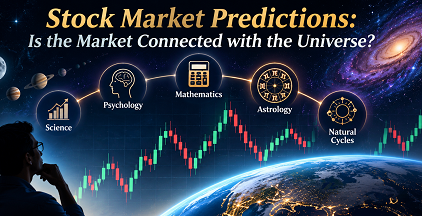
Stock Market Predictions
Look at the stock market from a distance, it appears to be a world of numbers. Prices rise, prices fall, millions of people buy and sell, and billions of rupees change hands every day. But look deeper and an interesting question appears: Is the stock market really an isolated system, or is it connected with the larger world around us?
Markets are influenced by almost everything happening in the world. Elections change expectations. Wars change commodity prices. Rainfall affects agricultural businesses. Seasons influence consumption. Interest rates influence borrowing and spending. Festivals change demand. Human fear and greed change prices. Even something happening thousands of kilometres away can affect your portfolio the next morning.
In that sense, the stock market is not separate from the world at all. It is constantly reacting to it.
The Market Is Ultimately a Reflection of Human Behaviour
A stock price may appear on a computer screen as a number, but behind that number are human decisions. Someone is buying because they expect something; someone else is selling because they expect something different.
That makes markets partly a study of human behaviour.
Fear, greed, hope, confidence, panic and patience have existed for centuries. Technology changes, companies change and trading systems change, but human emotions remain surprisingly familiar. This is one reason similar market patterns and cycles appear repeatedly across generations.
A booming market can make people believe prices will never fall. A falling market can make the same people believe prices will never recover. The circumstances change, but human reactions often repeat.
Mathematics Is Everywhere in the Market
Modern markets are filled with mathematics. Traders study price, volume, volatility, probability, averages, ratios and historical behaviour. Investors calculate earnings growth, valuations, returns and compounding. Quantitative trading systems can analyse enormous amounts of data looking for relationships invisible to the human eye.
Even technical analysis is largely an attempt to convert market behaviour into measurable patterns.
This is where the subject becomes much more controversial.
There are astrologers who study financial markets through planetary movements, planetary cycles and particular dates. Numerologists similarly look for relationships involving numbers, dates and recurring numerical patterns. Some practitioners claim to have identified important market periods in advance using these methods.
To someone who believes in these systems, this is not random guessing. It involves calculations, charts, dates, cycles and years of studying a particular methodology.
To someone who does not believe in them, the same process may look completely unrelated to the forces determining stock prices.
We already know that astronomical movements affect some things on Earth. The Earth’s rotation gives us day and night, its revolution around the Sun creates the annual cycle, and the gravitational relationship involving the Moon contributes strongly to ocean tides.
The controversial leap comes when someone argues that planetary configurations can also help anticipate human behaviour or financial-market cycles.
Financial astrology has followers who believe these relationships exist. Conventional financial economics does not regard planetary positions as an established, scientifically validated method for forecasting stock prices.
Those two facts can exist together. People can study a method seriously without that method having been scientifically established.
One reason such ideas continue attracting attention is that markets undeniably contain cycles.
There are economic cycles, interest-rate cycles, credit cycles, commodity cycles and business cycles. Markets move through periods of optimism, excess, fear, contraction and recovery. Individual industries also go through their own expansions and slowdowns.
Nature itself is full of cycles: days, seasons, years, biological rhythms and planetary movements.
It is therefore understandable why people throughout history have tried to determine whether financial cycles might somehow connect with larger natural cycles. Whether a particular theory successfully establishes that connection is a different question, but the curiosity itself is hardly surprising. An equity research analyst also works with numbers, but calculations alone are not enough. Understanding a company’s business, financial strength, valuation, and future prospects is equally important. Two analysts may study the same financial statements and still reach different conclusions because their assumptions about the future differ.
Is Trading Really Just “Satta”?
People sometimes dismiss trading by saying, “It is only gambling.”
But there is an important distinction.
Pure gambling primarily depends on predetermined probabilities and chance. Serious trading involves research, probability, risk management, position sizing, predefined exits and analysis of changing market conditions. A trader can still lose despite doing everything correctly because uncertainty can never be eliminated, but uncertainty alone does not make every activity gambling.
Running a business also involves uncertainty. Investing involves uncertainty. Agriculture involves uncertainty. An entrepreneur can calculate everything carefully and still fail. The presence of an uncertain outcome does not automatically mean that no calculation exists behind the decision. This is also where professional research becomes relevant. A sebi registered research analyst studies securities using a defined research process, but even a carefully researched recommendation can result in a loss. The difference between calculated risk-taking and blind speculation lies in understanding why a position is taken, what could go wrong, and when the original reasoning should be reconsidered.
Sometimes We Reject What We Don’t Understand
There is an old expression: “Angoor khatte hain” — the grapes are sour.
Human beings sometimes dismiss things they cannot understand, cannot achieve or cannot explain. Markets are complicated enough that two intelligent people can study exactly the same situation and reach completely different conclusions.
But the opposite mistake is equally important to avoid. Something does not become true merely because it sounds sophisticated or because a few predictions happened to work.
The sensible approach is curiosity combined with evidence.
If someone claims to predict markets through technical analysis, quantitative models, astrology, numerology or any other method, the real question should not simply be whether the method sounds strange. The better question is whether its results can be demonstrated consistently across a sufficiently large number of observations.
Perhaps the Market Is More Connected Than It Appears
The stock market certainly does not operate in isolation. It is connected with economics, politics, weather, technology, psychology, mathematics, businesses and events occurring throughout the world.
Whether that connection extends to planetary movements and numerological patterns remains a matter of belief, study and debate rather than established financial science.
But one thing is difficult to dispute: the deeper you study markets, the less they look like a simple game of prices going up and down.
Behind every movement lies an enormous network of businesses, people, expectations, calculations, events and reactions.
Perhaps that is why the stock market continues to fascinate everyone from economists and mathematicians to psychologists, astrologers and numerologists. They may use completely different methods, but they are ultimately trying to answer the same question:
Is there a pattern behind what appears to be randomness?
Disclaimer: This article is intended for general interest and educational purposes. References to astrology and numerology describe approaches followed by some practitioners and should not be interpreted as scientifically established methods of predicting securities markets or as investment advice.