SEBI Registered RA (INH000003507)
BSE Enlistment No:5203


Different types of investments
Investment is a very broad subject. From fixed deposits and gold to shares, mutual funds and real estate, there are numerous ways to invest money. But with so many choices, how do you decide which investment is right for you?
Our purpose here is not simply to list investment options. We want to help you understand how to select the right investment, at the right time and in the right way.
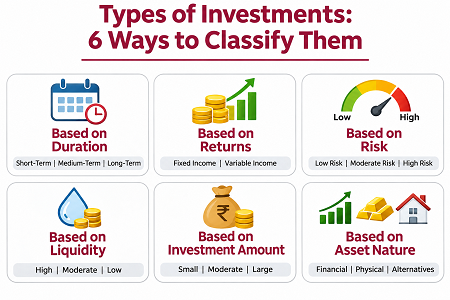
For this, you need to understand six important ways in which investments can be classified. Each classification answers a different question about your money, financial goals and expectations.
The first question is: How long can you keep your money invested? Your investment period plays an important role in deciding where your money should go.
Short-Term Investments (Up to 1 Year)
These are generally suitable when you need your money within a year. The priority is usually preserving capital and keeping money accessible.
However, short-term investing also includes stock market trading. For example, traders looking for stock recommendations tomorrow may participate in BTST opportunities, where positions are carried overnight. Such trading involves significantly different risks from short-term savings products.
Examples: Savings accounts, short-term fixed deposits, treasury bills, liquid mutual funds and short-term stock trading.
Medium-Term Investments (More Than 1 Year to 5 Years)
These investments are generally considered for goals such as purchasing a vehicle, arranging a house down payment or meeting future educational expenses. The appropriate choice depends on how much certainty and flexibility the investor needs.
Some investors also explore stock recommendations short term for market opportunities. However, equity trading should not be confused with capital-preservation investments intended for essential expenses.
Examples: Fixed deposits, selected debt funds, bonds and suitable hybrid mutual funds.
Long-Term Investments (More Than 5 Years)
Long-term investments are generally associated with wealth creation, retirement and other distant financial goals. Investors with a longer horizon may be better positioned to tolerate temporary market fluctuations, depending on their financial circumstances.
Investors interested in building an equity portfolio over several years may explore long term stock recommendations as part of their investment research.
Examples: Equity shares, equity mutual funds, ETFs, PPF, NPS and real estate.
Remember: Money needed next year should not necessarily be invested in the same way as money needed after 15 years.
The second question is: How do you want your investment to earn money? Not every investment generates returns in the same manner.
Fixed-Return Investments
These investments offer a predetermined interest rate or contractual payment. Suppose you invest ₹1 lakh in a fixed deposit offering 7% annual interest. You can calculate the expected interest according to its terms. However, fixed returns do not always mean zero risk. Creditworthiness, inflation and withdrawal conditions still matter.
Examples: Bank fixed deposits, recurring deposits, certain government savings schemes and fixed-coupon bonds.
Market-Linked Investments
Here, returns depend on market performance rather than a fixed promise. An investor purchasing shares may earn substantial returns if the business performs well, but losses are equally possible.
Investors looking for significant long-term capital appreciation sometimes explore a multibagger stock recommendation. Such investments carry uncertainty, and exceptional returns cannot be guaranteed.
Examples: Equity shares, equity mutual funds, ETFs, gold ETFs and market-linked debentures.
Regular Income Investments
Some people invest primarily to receive periodic income. These may appeal to retired individuals or investors seeking additional cash flow. However, dividends and rental income are not always guaranteed, and the underlying investment may fluctuate in value.
Examples: Interest-paying bonds, rental properties, dividend-paying shares, income-distributing REITs and certain government income schemes.
Capital Appreciation Investments
Here, the main objective is an increase in asset value. For example, purchasing land for ₹20 lakh and selling it years later for ₹35 lakh generates capital appreciation before expenses and taxes.
Examples: Equity shares, growth-oriented mutual funds, land, residential property and gold.
The key difference: Some investments are chosen for regular income, while others are chosen primarily for future growth. Certain investments may provide both.
The third question is: How much loss can you financially afford? Every investment carries risk, although the nature and extent of risk differ.
Low-Risk Investments
These generally focus on capital preservation and predictable outcomes. They may suit investors who cannot afford substantial losses. Even these investments can involve inflation, liquidity or other risks.
Examples: Treasury bills, eligible insured bank deposits, PPF and certain government-backed savings schemes.
Moderate-Risk Investments
These involve some uncertainty in exchange for potentially higher returns. Their actual risk depends on the underlying assets, credit quality, interest-rate sensitivity and product structure.
Examples: Selected high-quality debt mutual funds, conservative hybrid funds and certain investment-grade corporate bonds.
High-Risk Investments
Individual shares, concentrated small-cap portfolios, derivatives and speculative investments can experience substantial fluctuations. Higher potential returns often come with the possibility of significant losses.
Investors exploring stock market opportunities may come across share bazaar tips and trading recommendations. Before acting on them, it is important to understand the risks involved, as no recommendation can eliminate market uncertainty.
Examples: Small-cap shares, concentrated equity portfolios, stock futures, options and speculative securities.
An important distinction: Being willing to take risk and being financially capable of taking risk are two different things. A person may enjoy aggressive investing but still need to protect money reserved for family responsibilities.
The fourth question is: How quickly can you get your money back? Imagine owning property worth ₹50 lakh but urgently needing ₹2 lakh. You cannot easily sell one room to arrange the money! That is where liquidity becomes important.
Highly Liquid Investments
These are generally easier to convert into cash. However, selling shares quickly does not mean selling them profitably. Redemption and settlement periods also vary.
Examples: Savings accounts, liquid mutual funds, treasury bills and actively traded listed shares.
Moderately Liquid Investments
You may be able to access your money, but there could be charges, delays or price reductions. Liquidity can also change depending on market conditions and contractual restrictions.
Examples: Fixed deposits with premature-withdrawal penalties, certain corporate bonds and less actively traded listed securities.
Illiquid Investments
These may take considerable time to sell or redeem. Such investments can be valuable but may not help during an immediate financial emergency.
Examples: Land, residential property, commercial property, private equity and certain locked-in investment products.
Remember: Having wealth and having money available when needed are not the same thing.
The fifth question is: How much money do you need to start? Different investments require different amounts of capital. For easy understanding, we can group them into three broad categories. These are practical groupings, not fixed regulatory classifications.
Small-Ticket Investments
These can often be started with relatively limited money. Many SIPs begin at ₹500 or other scheme-specific amounts.
Even investing ₹2,000 every month means contributing ₹24,000 annually. Consistent investing can gradually build capital.
Examples: Mutual fund SIPs, recurring deposits, selected ETFs and individual shares.
Medium-Ticket Investments
Some investments become more practical with a larger amount, particularly when diversification is important.
For instance, purchasing one share may require little money, but creating a diversified portfolio of 20 companies may require considerably more capital.
Examples: Diversified direct-equity portfolios, selected bonds, physical gold and larger lump-sum mutual fund investments.
Large-Ticket Investments
These generally require substantial capital. Some Alternative Investment Fund categories generally require a minimum investment of ₹1 crore, subject to regulatory exceptions.
But having enough money to enter an investment does not automatically make it suitable.
Examples: Residential property, commercial real estate, private equity and Alternative Investment Funds.
The important lesson: Start according to your financial capacity. A large investment is not necessarily a better investment.
The sixth question is: Are you buying a physical asset or a financial asset? This classification helps explain what you actually own.
Physical Investments
These involve tangible assets that may provide personal use, rental income or capital appreciation. However, they can involve storage, maintenance, legal documentation, insurance and selling expenses.
Examples: Residential property, commercial buildings, agricultural land, physical gold and physical silver.
Financial Investments
These represent financial ownership, claims or contractual rights. Financial investments can often be purchased in smaller amounts and may be easier to diversify.
For example, buying commercial property directly may require lakhs or crores, whereas listed REIT units provide an alternative way to gain real estate exposure. Similarly, investors can purchase gold ETFs without personally storing physical gold.
Examples: Equity shares, bonds, mutual funds, ETFs, fixed deposits, government securities and REIT units.
Neither physical nor financial investments are automatically superior. Both serve different purposes.
Quick Comparison: Six Ways to Classify Investments
| Classification | What You Need to Decide |
| Duration | When will you need your money? |
| Returns | Do you want income, growth or both? |
| Risk | How much loss can you afford? |
| Liquidity | How quickly might you need cash? |
| Minimum Amount | How much can you comfortably invest? |
| Asset Nature | Do you prefer physical or financial assets? |
How to Select the Right Investment
Consider two investors. One has ₹5 lakh saved for a house down payment next year. Another has ₹5 lakh available for retirement planning after 20 years. Although both have the same amount, their investment choices may be completely different.
The first investor may prioritise liquidity and capital preservation. The second may consider diversified growth-oriented investments, depending on risk capacity. This is why investment selection should follow a sensible sequence.
First, identify your financial goal. Next, decide how long the money can remain invested. Then evaluate your risk capacity, expected returns, liquidity requirements and available capital. Finally, choose an appropriate combination of physical and financial assets.
When selecting individual shares, understanding company fundamentals, valuations and business risks becomes particularly important. An equity research analyst can provide research-based insights into listed companies. ABJ Finstocks, a sebi registered research analyst, provides stock recommendations for investors interested in equity market opportunities. Investors should evaluate these recommendations according to their financial goals and risk capacity.
Diversification is also important. Putting all your money into one company, property or asset category can create unnecessary concentration risk.
Conclusion: There Is No Single Best Investment for Everyone
Different types of investments exist because investors have different needs. A fixed deposit may suit one financial goal, while shares, mutual funds or real estate may suit another. Even the same investor may need different investments for different purposes.
The right investment is not necessarily the one offering the highest potential return. It is the one that matches your financial goal, investment duration, risk capacity, liquidity needs and available capital.
Understand these six classifications before investing. They can help you make better decisions about where, when and how to invest your money.