SEBI Registered RA (INH000003507)
BSE Enlistment No:5203


basics about trading
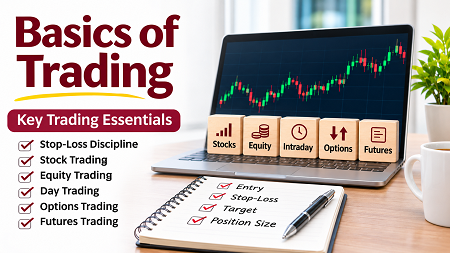
Basics of trading begin with one important rule: learn to accept a stop-loss before thinking about profits. Trading is very different from long-term investing. In trading, you enter a position expecting a price movement within a limited period, and if the market moves against you, you must be prepared to exit.
In long-term investing, a temporary fall may not necessarily change the original investment decision if the company’s fundamentals remain strong. In trading, however, holding a losing position without a plan can turn a manageable loss into a serious financial problem.
Many beginners spend their time searching for profitable strategies, technical indicators, and stocks that may rise tomorrow. But the first lesson in the basics of trading in stock market is understanding that losses are unavoidable. Even experienced traders cannot predict every market movement correctly.
A successful trading approach is not simply about identifying opportunities. It also involves protecting capital, managing emotions, selecting suitable instruments, and knowing when to stay away from the market.
Trading Basics for Beginners
The first rule of trading is simple: If you cannot execute a stop-loss, you should not be trading.
A stop-loss is a predetermined price level at which a trader intends to exit a position if the market moves in the wrong direction. It helps limit potential losses, although sudden price movements or execution delays can result in losses beyond the intended level.
Consider a trader who purchases a stock at ₹500 with a stop-loss at ₹485. If the price falls to the stop-loss level, the trader should follow the planned exit instead of hoping that the stock will recover.
The biggest difficulty is often psychological. When a trade moves into a loss, traders may hesitate because they do not want to accept that their decision was wrong. Some remove the stop-loss, while others purchase additional quantities to reduce their average buying price.
Such behaviour can make trading dangerous.
Think of trading like wrestling. If you are not prepared to take a punch, you cannot expect to win the match. Similarly, if you are not mentally prepared to accept losses, you cannot develop the discipline required for trading.
What Beginners Should Learn First
Before placing trades, understand these basic concepts:
Beginners should also avoid taking positions simply because someone claims a stock will rise. Trading decisions require a clear reason, defined risk, and an exit plan.
Those who prefer research-based trading recommendations can consider services from a SEBI RA such as ABJ Finstocks. However, even when following professional recommendations, traders must understand stop-loss discipline and manage their capital responsibly.
Stock trading offers a wide range of opportunities because thousands of companies are listed on Indian stock exchanges. Traders can choose among companies from banking, information technology, pharmaceuticals, automobiles, metals, infrastructure, and several other sectors.
This is one major difference between stock trading and index trading.
In index trading, the choice of underlying indices is relatively limited, with Nifty, Bank Nifty, and Sensex among the commonly followed benchmarks. In stock trading, however, traders can select from a much larger universe of individual companies.
For example, when the banking sector is weak but pharmaceutical stocks are showing strength, a stock trader may identify buying opportunities in selected pharmaceutical companies. An index trader generally focuses on the movement of the chosen index rather than selecting individual companies.
This flexibility can be an advantage, but it also creates a challenge. With so many stocks available, selecting the right company at the right time requires screening and analysis.
What Matters When Selecting Stocks?
Liquidity should be one of the first considerations. A stock may appear attractive on a chart, but if trading volumes are low, entering or exiting at the desired price may become difficult.
Traders should also examine price trends, support and resistance levels, trading volumes, and overall market conditions.
Another important decision is the holding period. Some traders prefer intraday positions, while others hold stocks for several days or weeks.
Those who cannot monitor the market continuously may prefer stock recommendations short term, where the objective is to capture price movements over a longer period rather than react to every intraday fluctuation.
Understanding these differences is an important part of learning the basics about trading.
Equity trading generally refers to buying and selling shares of listed companies. In everyday stock market discussions, the term is often used for trading in the cash market, where investors purchase or sell actual company shares.
However, equity-related trading can also include derivatives such as stock futures and options.
One important advantage of cash market equity trading is accessibility. It is available to retail investors, high-net-worth individuals (HNIs), and institutional participants.
Unlike futures contracts, cash market trading does not require purchasing a fixed contract lot. An investor can generally purchase even one share, provided sufficient funds are available and the share is eligible for trading.
For example, if a share trades at ₹300, an investor may purchase one share for approximately ₹300 plus applicable charges. Futures trading, on the other hand, involves prescribed contract lot sizes and margin requirements.
Cash Market Versus Derivatives
| Feature | Cash Market | Futures and Options |
| Trading Instrument | Company shares | Derivative contracts |
| Minimum Quantity | Generally one share | Contract lot size |
| Capital Requirement | Based on share price and quantity | Based on premium or applicable margin |
| Leverage | Depends on product and broker | Can involve significant leverage |
| Complexity | Relatively straightforward | More complex |
Cash trading is generally easier for beginners to understand because the relationship between the share price and the value of the holding is direct.
Derivatives introduce additional factors such as contract expiry, margin requirements, volatility, and leverage.
An equity research analyst may evaluate stocks using company fundamentals, price movements, and other research methods depending on whether the objective is trading or investing.
Day Trading Basics
Day trading, also called intraday trading, involves opening and closing positions within the same trading session.
It is one of the most demanding forms of trading because decisions must be made quickly, often while prices are changing rapidly.
One advantage is that intraday traders generally avoid overnight gap risk because positions are closed before the market shuts. The trader can monitor the position while the market is open and respond to changing conditions.
However, intraday trading should not automatically be considered less risky. Sudden volatility, leverage, slippage, and emotional decisions can cause substantial losses within minutes.
The biggest challenge is often psychology. Traders may book small profits too early, hold losing trades for too long, or increase quantities after a loss in an attempt to recover money.
A disciplined day trader should have a clear entry level, stop-loss, target, and maximum acceptable loss for the day.
Beginners who need trading recommendations should prefer a SEBI-registered Research Analyst rather than unregistered tip providers or social media groups promising assured profits. Registration provides a regulatory framework, but it does not guarantee successful trades.
Options Basics
Options are financial derivatives whose value depends on an underlying asset, such as a stock or market index.
The two main types are:
Options are a deep and complex subject. Their prices are influenced not only by the direction of the underlying asset but also by factors such as time remaining until expiry, volatility, and changes in market expectations.
This makes options trading more complicated than directly trading shares or tracking the movement of an underlying index.
A trader may correctly predict that Nifty will rise but still lose money on a purchased call option because of time decay, a decline in implied volatility, or an unfavourable entry price.
Understanding Options Payoff
Before trading options, it is important to understand how potential profits and losses change at different underlying prices.
An options payoff chart helps traders visualise possible outcomes at expiry for strategies such as buying calls, buying puts, and option spreads.
Traders can explore payoff analysis using StockMock, an options strategy analysis platform. Such tools can help explain strategy behaviour, but simulated outcomes should not be mistaken for guaranteed results.
Beginners should first understand the underlying stock or index before moving into derivatives. Direct cash market trading is generally simpler because it does not involve option premiums, time decay, or option Greeks.
For traders seeking research-based index trading opportunities, ABJ Finstocks offers services under its SEBI registered option tips provider category. Traders should still understand option risks and follow appropriate position sizing and stop-loss discipline.
Futures Trading Basics
Futures are derivative contracts that allow traders to take positions based on the expected movement of an underlying stock or index.
Unlike purchasing shares in the cash market, futures trading involves standardised contracts with specified lot sizes and expiry dates.
A futures trader can take a long position when expecting prices to rise or a short position when expecting prices to fall.
One major difference is the margin requirement. Traders do not ordinarily pay the full notional contract value upfront. Instead, they must maintain the margin required by the exchange and their broker.
This creates leverage, which can magnify both profits and losses.
Understanding SPAN Margin
Before entering a futures position, traders must understand SPAN margin.
SPAN stands for Standard Portfolio Analysis of Risk. It is a risk-based margin calculation system used to assess potential losses under different market scenarios.
In India, applicable derivatives margins include SPAN-based requirements and additional margins prescribed by the exchange or clearing corporation.
Traders can refer to the official NSE Clearing SPAN information to understand the exchange’s margin framework.
For example, a trader may control a futures position with a notional value much larger than the margin deposited. While this increases trading exposure, it also means that a relatively small adverse price movement can cause a significant loss compared with the capital committed.
Margin requirements may also change with volatility and exchange regulations. Therefore, traders should check current requirements before placing orders.
The most important lesson in the basics of trading in stock market remains the same across cash stocks, intraday trading, options, and futures: protect your capital first.
Trading provides opportunities, but no strategy eliminates losses. Understanding the instrument, controlling position size, following stop-loss rules, and accepting that not every trade will succeed are essential habits for anyone entering the stock market.