SEBI Registered RA (INH000003507)
BSE Enlistment No:5203


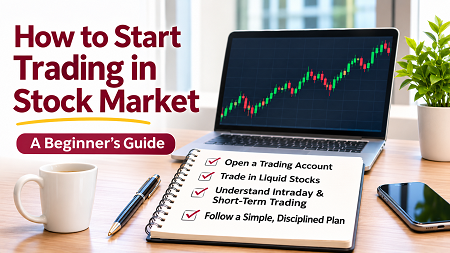
How to Start Trading in Stock Market
How to start trading in stock market is one of the first questions people ask when they want to participate in the share market. Opening a trading account is relatively easy, but understanding when to buy, when to sell, and how much money to risk requires preparation. Many beginners enter the market expecting quick profits without understanding how trading actually works.
Stock market trading involves buying and selling shares to benefit from price movements. Some traders buy and sell within the same day, while others hold positions for a few days or weeks. The right approach depends on how much time you can spend monitoring the market, your available capital, and your ability to handle losses.
Before placing your first trade, understand the difference between trading and investing. Trading generally focuses on shorter-term price movements, while investing involves holding shares for longer periods based on business performance and growth prospects.
It is also important to understand that a profitable trade is never guaranteed. Even experienced traders face losses. The objective should be to develop a disciplined approach rather than expect every recommendation or trading decision to produce a profit.
Beginners who need professional research support can consider starting with a SEBI research analyst instead of depending entirely on social media recommendations or unverified market messages. A registered research analyst can provide research-based stock recommendations, although registration does not guarantee trading performance.
To begin trading in India, you generally need a trading account and a Demat account with a SEBI-registered stockbroker or depository participant. The trading account allows you to place buy and sell orders, while the Demat account holds the shares you own electronically.
Opening these accounts has become much easier because most brokers provide an online registration process.
Steps to open a trading account:
Discount Brokers or Full-Service Brokers?
If you plan to trade frequently and are comfortable using technology, a discount broker may be a practical choice. Discount brokers generally offer online trading platforms with competitive brokerage charges.
Two well-known discount brokers in India are:
Both provide digital account-opening facilities and trading applications. However, brokerage charges, account fees, and available features should be checked before selecting a broker.
Full-service brokers may be suitable for people who prefer additional assistance, branch support, or other services. The choice depends on individual requirements.
For active traders, brokerage costs become particularly important because frequent transactions can reduce net profits. Apart from brokerage, consider securities transaction tax, exchange transaction charges, GST, stamp duty, and other applicable costs.
Opening a trading account does not mean you are ready to trade immediately. Spend time understanding order types, market orders, limit orders, stop-loss orders, and how trades are settled.
Once your trading account is active, the next step is deciding which stocks to trade. Beginners often make the mistake of selecting shares simply because they are inexpensive or have recently increased sharply.
A better starting point is to focus on liquid stocks, whether you intend to buy or sell.
Liquidity means there are enough active buyers and sellers in a stock to make transactions relatively easy. Highly liquid stocks generally have narrower bid-ask spreads and allow traders to enter or exit positions with less difficulty.
For example, suppose you purchase a stock expecting a short-term rise. If trading activity is low, you may struggle to sell at your desired price even when your market view is correct.
Liquidity becomes especially important when selling shares short or closing positions quickly. Poor liquidity can increase slippage and create unexpected losses.
What Should You Check Before Buying a Stock?
Before entering a trade, examine a few basic factors:
Do not assume that every stock showing a sharp rise will continue moving upward. Similarly, a stock that has fallen significantly is not automatically a buying opportunity.
Should Beginners Start With BTST Trading?
BTST stands for Buy Today, Sell Tomorrow. In this approach, traders buy shares during one trading session and plan to sell them in the next session.
BTST allows traders to participate in potential overnight price movements without continuously monitoring every minute of the market. However, it introduces overnight risk because prices may open significantly higher or lower due to news or market developments.
For traders exploring next-session opportunities, tomorrow trading tips can help them understand research-based BTST recommendations and the risks associated with carrying positions overnight.
Beginners should remember that BTST is not automatically safer than intraday trading. Overnight price gaps can sometimes make losses larger than expected.
Start with limited capital, understand the trading process, and gradually develop experience before increasing your exposure.
Intraday trading means buying and selling stocks within the same trading session. All positions are closed before the market closes, so traders generally do not carry overnight exposure.
One advantage of intraday trading is that traders can define their risk through position sizing, stop-loss orders, and planned exits. However, this does not mean losses are always fully controllable. Sudden price movements, slippage, and execution delays can cause losses beyond the intended stop-loss level.
The biggest challenge in intraday trading is often psychology rather than identifying a trading opportunity.
A trader may correctly identify the market direction but still lose money because of fear, greed, impatience, or hesitation. For example, some traders book profits too early but allow losing positions to continue. Others increase their trading quantity after a loss, hoping to recover their money immediately.
Intraday trading can also involve frequent false signals. Short-term price movements are influenced by market volatility, sudden buying or selling pressure, and rapidly changing sentiment. As a result, achieving consistent accuracy can be difficult, although there is no universal evidence that intraday trading has the lowest accuracy among all trading styles.
Basic Rules for Intraday Trading
Beginners should also understand the difference between intraday trading in cash stocks and trading in futures or options. Derivatives can involve leverage and additional risks that may not be suitable for inexperienced traders.
Those who find independent technical analysis difficult may consider trading recommendations from a SEBI registered research analyst. ABJ Finstocks provides research-based trading recommendations, including intraday opportunities, with communicated entry, stop-loss, and target levels.
However, following recommendations does not eliminate market risk. Traders must still manage capital, execute orders responsibly, and maintain discipline.
For beginners, starting with short-term stock trading may be more practical than immediately entering intraday trading. Short-term trading generally involves holding shares for several days or weeks, allowing more time to evaluate price movements and make decisions.
Intraday trading has the advantage of avoiding overnight exposure, but it demands continuous attention and strong emotional control. Beginners may not yet understand how quickly fear, greed, and market volatility can affect their decisions.
Short-term trading provides more time to study charts, identify important price levels, and assess whether a trade is developing as expected. However, it also involves overnight and weekend risks, so it should not be considered risk-free.
A Practical Approach for Beginners
A beginner can start by following a simple process:
Beginners who prefer research-based stock selection can explore best share to buy today for short term recommendations from ABJ Finstocks. These opportunities are intended for traders who prefer holding positions beyond a single trading session rather than making repeated intraday decisions.
It is equally important to understand that trading success cannot be measured by one profitable trade or a few successful recommendations. What matters is how consistently a trader follows a process, manages losses, and avoids unnecessary risks.
The purpose of starting stock market trading should be to build knowledge, discipline, and experience before attempting to increase profits. Choosing a suitable trading style, understanding the risks, and following a structured approach can help beginners make more informed decisions in the stock market.