SEBI Registered RA (INH000003507)
BSE Enlistment No:5203


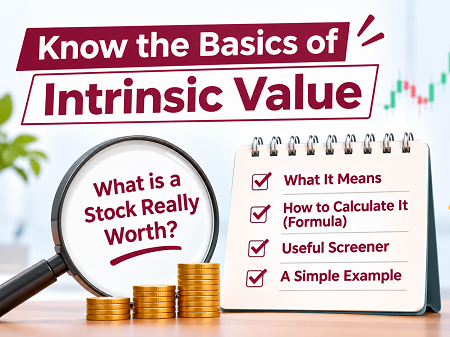
intrinsic value of stock or share
The intrinsic value of stock, also known as the intrinsic value of share, is an important concept for investors who want to understand what a company may actually be worth rather than simply relying on its current market price. Every day, share prices move because of market sentiment, company announcements, economic developments, and investor expectations. However, the price displayed on a stock exchange does not necessarily represent the underlying value of a business.
Intrinsic value helps investors assess whether a stock appears undervalued, fairly valued, or overvalued. It encourages investors to look beyond short-term price movements and examine a company’s earnings, cash flows, growth prospects, financial strength, and future potential. Understanding intrinsic value is particularly useful for investors following a long-term investment approach.
Intrinsic value is the estimated economic worth of a company or its shares, calculated using financial information, expected future performance, and reasonable assumptions about business growth and risk.
In simple words, intrinsic value attempts to answer one question: What should this stock be worth based on the company’s business fundamentals?
For example, suppose a company’s share is trading at ₹800, but an investor estimates its intrinsic value at ₹1,000. Based on that valuation, the stock may appear undervalued. Conversely, if its estimated intrinsic value is ₹600, the same stock may appear overvalued.
The relationship can be understood as follows:
However, intrinsic value is not a fixed or universally accepted number. Two analysts may calculate different values for the same company because their assumptions about future growth, profitability, and business risks differ.
This is why fundamental analysis plays an important role in identifying investment opportunities. Investors who prefer professional evaluation can also refer to an equity research analyst to understand how businesses are assessed using financial information, valuation methods, and long-term prospects.
There is no single intrinsic value formula suitable for every company. Different valuation methods are used depending on the company’s business model, financial performance, and availability of reliable information.
One widely used approach is the Discounted Cash Flow (DCF) method, which estimates the present value of a company’s expected future cash flows.
1. Discounted Cash Flow (DCF) Formula
\[ PV=\sum_{t=1}^{n}\frac{FCF_t}{(1+r)^t} \]
Where:
For a complete company valuation, analysts also consider the value of cash flows beyond the forecast period, commonly called terminal value. They then make appropriate adjustments for debt, cash, and other claims before arriving at the value attributable to equity shareholders.
\[ \text{Intrinsic Value Per Share}= \frac{\text{Estimated Equity Value}}{\text{Shares Outstanding}} \]
The DCF method is particularly useful for companies with relatively predictable cash flows. However, even small changes in growth assumptions or discount rates can significantly affect the estimated intrinsic value.
2. Earnings-Based Valuation
Another commonly used method estimates the value of a share based on earnings per share (EPS) and a reasonable price-to-earnings (P/E) multiple.
\[ \text{Estimated Value Per Share}=\text{EPS}\times\text{Assumed Fair P/E} \]
Suppose a company earns ₹40 per share annually and an investor considers a P/E multiple of 20 appropriate.
Estimated value = ₹40 × 20 = ₹800 per share.
This is a simplified valuation approach, not a guaranteed intrinsic value. The selected P/E multiple must be justified by factors such as business quality, earnings growth, industry conditions, and risk.
3. Asset-Based Valuation
For certain businesses, particularly asset-heavy companies, investors may estimate value by examining the company’s assets and liabilities.
\[ \text{Net Asset Value}=\text{Assets}-\text{Liabilities} \]
Dividing the estimated net assets attributable to ordinary shareholders by the number of outstanding shares provides an asset-based value per share.
However, book values may differ from actual market values, and this method may not adequately capture the earnings potential of businesses with valuable brands, technology, or other intangible assets.
For long-term investors, valuation is only one part of the investment process. Selecting companies with sustainable businesses and reasonable valuations is equally important. Investors exploring long term stock recommendations should consider both the estimated value of a company and its ability to sustain or improve its business performance.
Intrinsic Value Screener
Websites to Check Stock Valuations
Calculating intrinsic value manually requires financial data, forecasting assumptions, and an understanding of valuation methods. An intrinsic value screener can simplify the initial research process by displaying valuation estimates and relevant financial ratios.
These tools help investors compare market prices with estimated fair values and identify companies that deserve further examination.
1. Screener.in
Screener.in – Intrinsic Value Screener
Screener.in is particularly useful for analysing Indian listed companies. Investors can examine earnings, profitability, debt, valuation ratios, and intrinsic value estimates. Its intrinsic value calculation uses a modified Graham Number approach based on earnings, book value, growth, and return on capital employed.
Important: Different screeners may show different intrinsic values for the same stock because their formulas, assumptions, and available financial information differ. A screener should be treated as a starting point for research rather than a final investment decision.
Investors who follow market developments through share bazaar tips should also understand the difference between a technically attractive stock and a fundamentally undervalued business. A favourable market trend does not automatically mean that the stock is trading below its intrinsic value.
Intrinsic Value Example
Consider a hypothetical company named ABC Industries Ltd. The following example demonstrates how an investor can estimate a share’s value using a simplified earnings-based valuation method.
Assume the company has the following financial characteristics:
| Particulars | Value |
| Current Market Price | ₹600 |
| Earnings Per Share (EPS) | ₹40 |
| Assumed Fair P/E Ratio | 20 |
| Estimated Intrinsic Value | ₹800 |
| Difference from Market Price | ₹200 |
The estimated intrinsic value is calculated as follows:
\[ ₹40\times20=₹800 \]
According to this calculation, the estimated value of the share is ₹800, while its market price is ₹600.
This means the stock trades at a 25% discount to its estimated intrinsic value.
\[ \text{Discount}=\frac{800-600}{800}\times100=25\% \]
This difference is commonly described as a margin of safety.
Understanding the Margin of Safety
The margin of safety represents the difference between a stock’s estimated intrinsic value and the price an investor pays.
For example, if an investor estimates a share’s intrinsic value at ₹800 but purchases it at ₹600, the investor has a valuation cushion of ₹200 per share.
However, this cushion exists only if the intrinsic value estimate is reasonably accurate. If the company’s earnings deteriorate or its business outlook weakens, its actual value may be lower than originally estimated.
Therefore, purchasing a stock below its calculated intrinsic value does not guarantee a profit.
What If the Share Price Rises?
Suppose ABC Industries’ share price increases from ₹600 to ₹750 while the estimated intrinsic value remains ₹800.
The stock would still trade below the estimated value, but the margin of safety would decline from 25% to 6.25%.
At ₹900, the share would trade above the estimated intrinsic value.
This example demonstrates why the price paid for an investment matters. Even a financially strong company can become an unattractive investment when its market valuation is excessively high.
Why Intrinsic Value Alone Is Not Enough
A low market price compared with estimated intrinsic value does not automatically make a stock suitable for investment. Investors must also consider the company’s management, debt obligations, competitive position, profitability, and future business prospects.
Sometimes a stock appears undervalued because the market anticipates genuine difficulties that have not yet become visible in its reported financial results. Such situations are commonly called value traps.
On the other hand, companies with strong growth opportunities may justify higher valuations when their future earnings potential supports those expectations.
This becomes especially relevant when evaluating smaller companies with long-term expansion potential. Investors exploring multibagger stock recommendation services should understand that identifying potential multibaggers requires more than finding shares trading below a calculated intrinsic value. Business scalability, sustainable growth, financial discipline, and valuation are all important considerations.
How Investors Can Use Intrinsic Value Effectively
Intrinsic value is most useful when treated as a range of reasonable estimates rather than one perfectly accurate number.
For example, an investor might estimate a company’s value under three assumptions:
| Valuation Scenario | Estimated Value |
| Conservative Growth | ₹650 |
| Moderate Growth | ₹800 |
| Optimistic Growth | ₹1,000 |
If the market price is ₹600, the stock may appear attractive under all three scenarios. However, the strength of the investment case still depends on whether the underlying assumptions are realistic.
Investors should periodically reassess valuations when companies announce financial results, undertake significant acquisitions, increase borrowings, or experience major changes in their business environment.
A valuation calculated several years ago may no longer reflect the company’s financial position.
Finding Intrinsically Valuable Stocks With ABJ Finstocks
Understanding intrinsic value is relatively straightforward, but identifying suitable stocks from thousands of listed companies requires time, research, and continuous evaluation. Investors must examine financial statements, compare businesses, assess valuations, and understand the risks associated with individual companies.
For investors who find this process difficult, ABJ Finstocks, a SEBI registered research analyst, provides stock recommendations based on its research process, which incorporates fundamental and technical analysis.
The objective is to help investors identify investment opportunities without requiring them to independently screen and evaluate every listed company. Nevertheless, intrinsic value remains an estimate, and investment decisions should consider individual risk tolerance, financial objectives, and investment horizons.
Conclusion
The intrinsic value of a stock helps investors distinguish between a company’s estimated economic worth and its prevailing market price. By understanding valuation formulas, using intrinsic value screeners, and examining financial fundamentals, investors can make more informed assessments of investment opportunities.
However, no valuation formula can eliminate uncertainty. Intrinsic value should be combined with business quality, financial strength, growth prospects, and sensible investment discipline rather than used as the sole reason for purchasing a share.
SEO Title: Intrinsic Value of Stock or share: Meaning, Formula & Example
Meta Description: Learn the intrinsic value of stock and share, its formula, practical examples, and how to use an intrinsic value screener to evaluate stocks.
URL Slug: intrinsic-value-of-stock/
Focus Keyword: intrinsic value of stock
Secondary Keywords: intrinsic value of share, intrinsic value formula, intrinsic value screener, intrinsic value example, define intrinsic value